Spent today with the Qwen-RobotWorld technical report (Qwen Team, June 2026). It’s a language-conditioned video world model for embodied intelligence: instead of robot-specific action formats (joint angles, waypoints, steering commands), it uses natural language as a single, unified action interface and predicts the future video given the current observation plus an instruction.
The part that caught my attention is the unification — one model spans robotic manipulation, autonomous driving, indoor navigation, and human-to-robot transfer, trained jointly so each domain’s physics reinforces the others.
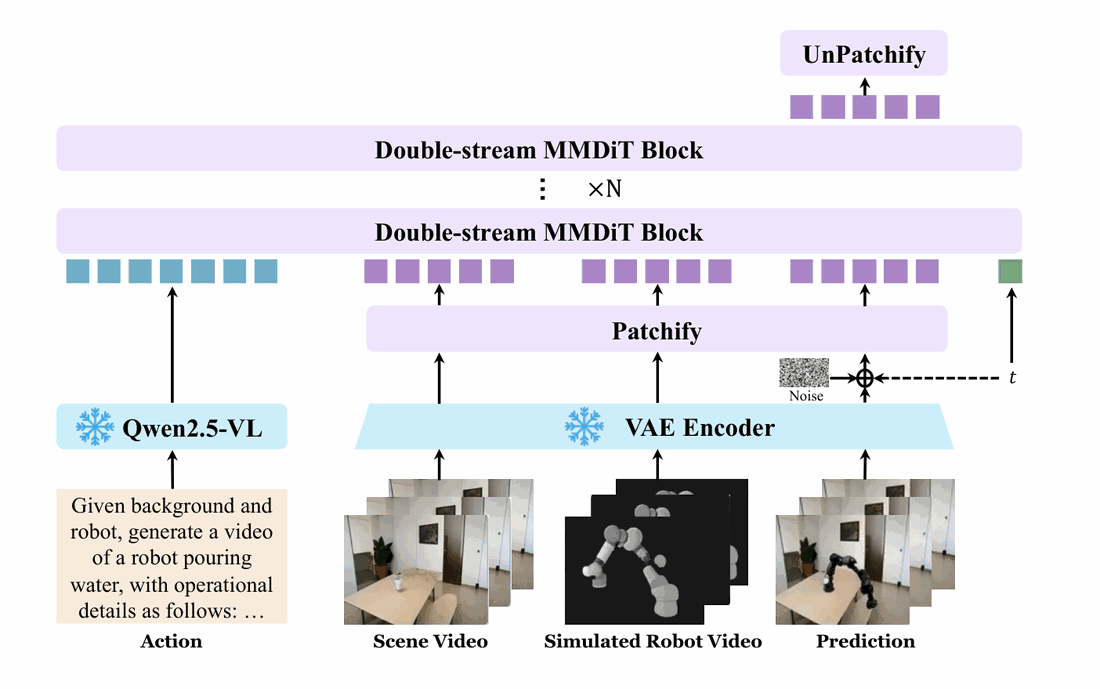
Architecture (Fig. 4): a frozen Qwen2.5-VL encodes the instruction (the action), a VAE encodes the visual state, and the two streams fuse via joint attention inside each Double-Stream MMDiT block to predict future frames.
Key points
- Language as the action. A state-transition model
s_{t+1} = f(s_t, a_t)where the actiona_tis just an instruction like “pick up the red cup and place it on the shelf” — no per-robot control API needed. - Architecture — Double-Stream MMDiT. A 60-layer double-stream diffusion transformer with an understanding stream (frozen Qwen2.5-VL encoding the instruction) and a generation stream (video-VAE latents = the visual state), fused by layer-wise joint attention. Using an MLLM rather than T5/CLIP brings world knowledge that constrains transitions to physically plausible ones.
- Data — the EWK corpus. ~8.6M video–text pairs (200M+ frames), an action-language mapping standardizing 20+ embodiments and 500+ action categories, with hierarchical five-layer captions and LLM+human quality filtering. ~1.6M samples carry synchronized 2–4 view concatenations.
- Training — General + Expert curriculum. Two stages: learn broad visual priors first, then inject embodied specialization under the shared language interface. Asymmetric 3D RoPE + multi-view concatenation give cross-camera geometric consistency without architectural changes.
- Three applications. (1) a synthetic-data engine for policy training, (2) virtual environments for policy evaluation, (3) language-guided planning signals for downstream control.
- Results. 1st overall on EWMBench (4.60) and DreamGen Bench (4.952); beats all open-source models on WorldModelBench (8.99) and PBench (0.804); near-perfect physics-adherence scores; plus zero-shot generalization on RoboTwin-IF.
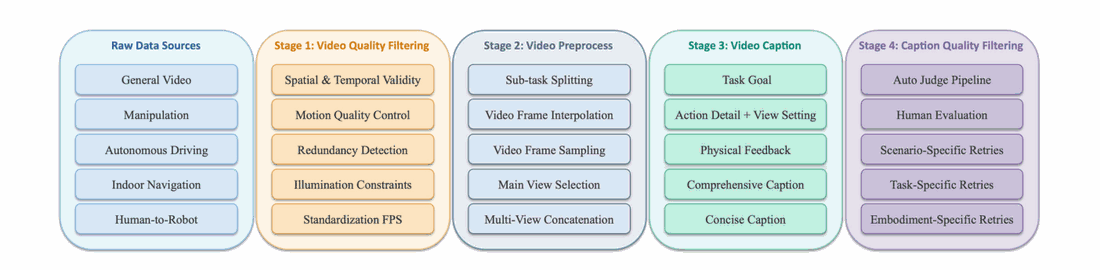
Data pipeline (Fig. 2): five raw sources → quality filtering → preprocessing → five-layer hierarchical captioning → caption-quality filtering, yielding the 8.6M-pair EWK corpus.
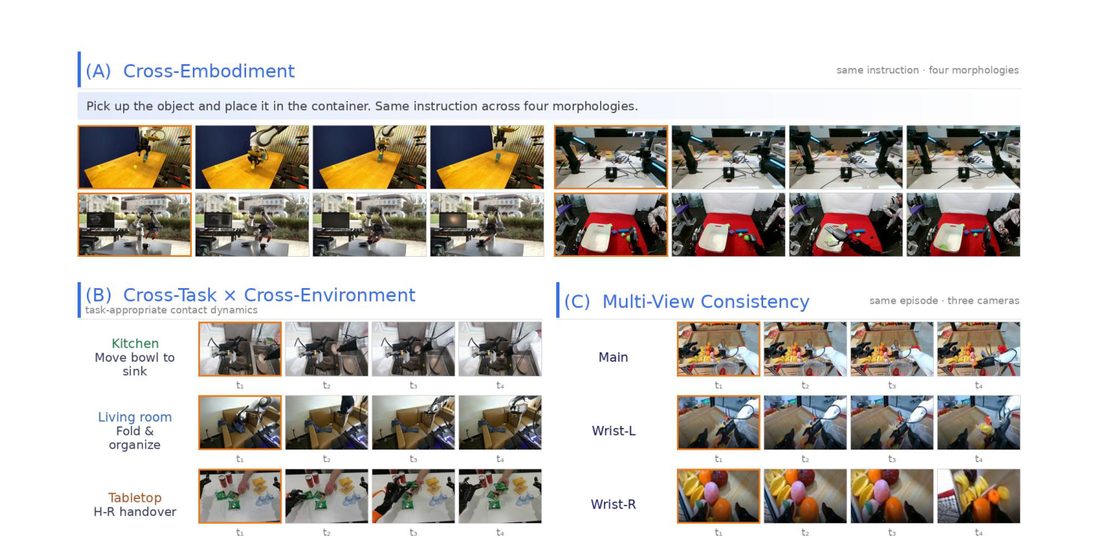
Generalization (Fig. 6): (A) one instruction drives four robot morphologies, (B) the same skill transfers across tasks and scenes, and (C) synchronized camera views stay mutually consistent.
Why I’m noting it
The “language as the universal action space” framing is what I want to sit with — a clean way to unify wildly different embodiments under one backbone. And the human-to-robot video transfer (synthesizing robot execution from a human demo, with no robot-specific prompt) hints at a real path to scaling embodied training data beyond what physical robots can collect.